Not sure what to ask for? Ideas for every stage
Last updated
When people ask how they can help, name one specific thing: a ride, a meal on a certain night, an hour of company, a call to the insurance company. Below are real examples for every stage, from the first days after a diagnosis through treatment and recovery, each with where to add it on your Flote so people can sign up without you keeping track.
Why is asking for help so hard?
Most of us would rather say "we're fine" than name what would help. It can feel like being a burden, or like admitting things are harder than we want them to look.
"When my dad was sick, a lot of friends offered to help and checked in on us. But I still felt bad asking for anything direct. Part of me felt I should be able to handle it, and part of me worried people would think I couldn't."
Veronica Pulido, Co-Founder of Aflote
If that sounds familiar, you are not alone in feeling alone: nearly 1 in 4 family caregivers say they feel socially isolated.
Psychologist Susan Silk has a simple picture for this, called Ring Theory. Draw a circle with the person who is sick in the middle. Around it, a ring for the people closest to them, then a ring for the next closest, and so on outward. The rule is "comfort in, dump out": support flows toward the center, and people vent their own worries to someone further out.
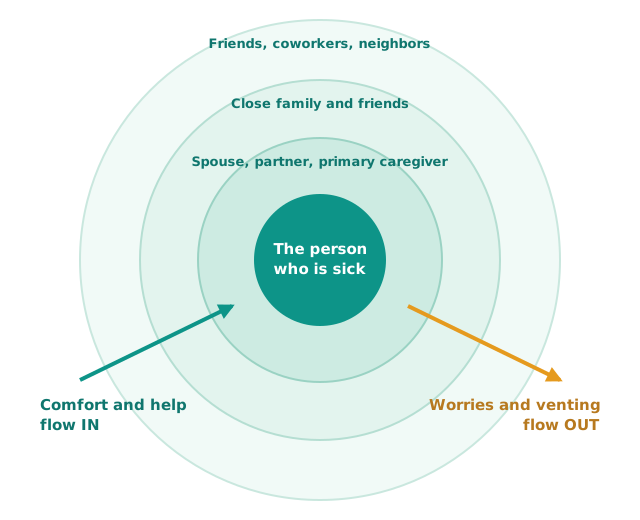
If you are at or near the center, that means help is supposed to flow to you. Asking for it is not imposing. It is how the circle is meant to work.
And people say yes more often than we expect. In one study, people asking for help underestimated how many others would agree by as much as half.
How do I ask so people actually say yes?
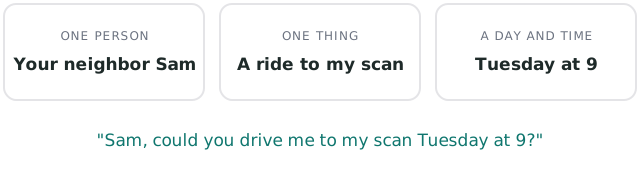
- Name the task, the day and the time. "Could you drive me to my scan Tuesday at 9?" is easy to answer. "Let me know if you need anything" is not.
- Ask one person for one thing. Text two or three people you are fairly sure will say yes before you share more widely.
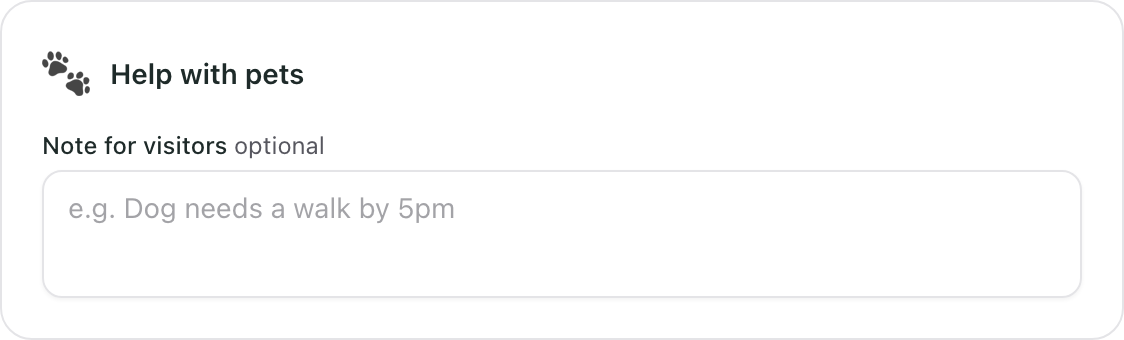
- Put it on your Flote. Add each ask once, with a short note saying exactly what would help, and people can sign up without you managing a group text. Add something you need help with shows how.
If you have shared your Flote and nobody has signed up yet, here is what usually helps.
What are examples of things I can ask for at each stage?
Every situation is different, and the stages often overlap. Take the ideas that fit and skip the rest. Each stage ends with where to add those asks on your Flote, using the ways to help below.
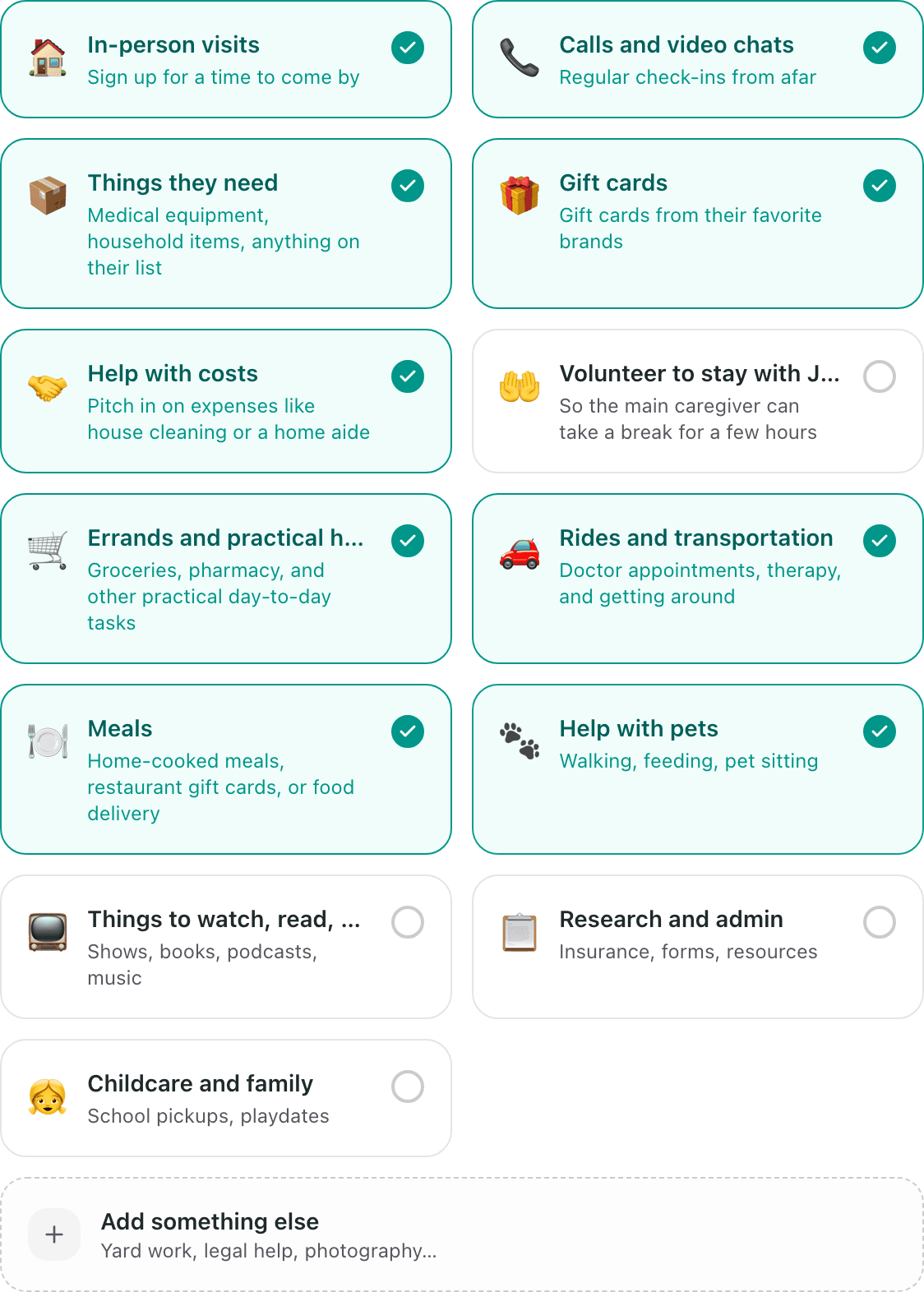
Choose a stage to see examples for it
Just diagnosed
- "Could you come with me to my next appointment and help take notes?"
- "Would you help me sort out the paperwork and make a list of questions for the doctor?"
- "Could you let everyone know what's going on, so I don't have to keep repeating it?"
- "Would you set up our Flote and help coordinate, so I don't have to?"
- "Could you just sit with me for a while? I don't want to be alone tonight."
- "Could you pick up dinner for us tonight?"
On your Flote: add Rides and transportation and put the appointment on your Calendar. Add Research and admin for paperwork. Post an Update once instead of answering every text. Make a trusted person an admin so they can coordinate with you (roles and permissions). Add In-person visits or Volunteer to stay with for company, and Meals for dinners.
Tests and scans
- "Could you drive me to my scan, lab work or biopsy?"
- "Would you watch the kids while I'm at appointments?"
- "Would you pick up groceries or my prescriptions?"
- "Could you help me understand this insurance form?"
- "Would you help me find reliable information about my diagnosis?"
- "Would you sit with me while I wait for results?"
- "Could you walk the dog this week?"
On your Flote: Rides and transportation, with each appointment on your Calendar so your circle can see what's coming up. Childcare and family, Errands and practical help, Research and admin, Volunteer to stay with, and Help with pets.
Planning treatment
- "Would you come with me to talk through my treatment options?"
- "Could you help me write down questions before the appointment?"
- "Would you help me compare the options my doctor gave me?"
- "Could you look into financial assistance or support programs for us?"
- "Could you drive me to my consultation or second opinion?"
- "Could you check in with me after appointments?"
- "Would you help me prepare a few meals before treatment starts?"
On your Flote: Research and admin for comparing options and finding programs. Rides and transportation with the appointment on your Calendar. Calls and video chats for check-ins. Meals. For anything that does not fit a category, like coming along to a specific appointment, choose Add something else and write your own.
During treatment
- "Would you drive me to or from treatment?"
- "Would you watch the kids on treatment days?"
- "Could you pick up prescriptions or groceries?"
- "Would you help with laundry, dishes or cleaning?"
- "Would you take the trash to the curb on treatment weeks?"
- "Could you walk the dog or feed the cat?"
- "Would you sit with me during treatment, if visitors are allowed?"
- "Could you come over and watch a movie, or just keep me company?"
- "Do you have a show, book or podcast to recommend for long infusion days?"
- "Could you bring dinner one night this week?"
On your Flote: Rides and transportation with treatment dates on your Calendar, so someone can claim each one. Childcare and family, Errands and practical help, Help with pets, Volunteer to stay with, In-person visits, Things to watch, read, or listen to, and Meals. If a cleaner or a home aide would take the most weight off, you can also ask for help with costs.
After treatment
- "Would you go for a walk with me?"
- "Could we plan something simple together when I'm ready?"
- "Could you still check in on me every now and then, even though treatment is over?"
- "Could you just listen? I don't always need advice."
- "Could you drive me to my follow-up appointments?"
- "Would you bring dinner once in a while while I'm still recovering?"
- "Will you celebrate this milestone with me?"
On your Flote: keep Calls and video chats and In-person visits on, so people know you still want company. Rides and transportation with follow-ups on your Calendar. Meals for as long as it helps. Post an Update to share what kind of support is still useful, and to celebrate milestones.
Follow-up care
- "Would you help me remember my upcoming appointments?"
- "Would you come with me on scan days?"
- "Could you check in with me every once in a while?"
- "Want to grab a coffee or just spend some time together?"
- "Could you water my plants while I'm away?"
- "Could you help with the yard work?"
- "Would you pick up a few groceries for me if you're already at the store?"
- "Would you be willing to be my emergency contact?"
On your Flote: keep appointments on your Calendar. Calls and video chats, In-person visits, and Errands and practical help. Add the people to call in an emergency to Key Contacts.
Frequently asked questions
What if I don't know what I need yet?
Start with the two things that would take the most weight off this week, often rides and meals, and add more as you find out. You do not need the whole list on day one.
Is it okay to ask the same person more than once?
Yes. Some people would rather help regularly, like every Tuesday ride, than once. Asking also gives them a clear way to show up.
What if someone says no?
A no to one thing is not a no to helping. Thank them, and ask someone else. People often can't do a particular day and would gladly take another.
How do I ask without feeling like a burden?
Remember the circles: help is meant to flow toward you. Many people who say "let me know if you need anything" mean it. A specific ask gives them a way to follow through.
Sources
- AARP and the National Alliance for Caregiving, Caregiving in the U.S. 2025, July 2025.
- Susan Silk and Barry Goldman, "How not to say the wrong thing," Los Angeles Times, April 7, 2013.
- Francis J. Flynn and Vanessa K. B. Lake, "If you need help, just ask: Underestimating compliance with direct requests for help," Journal of Personality and Social Psychology 95(1), 2008.